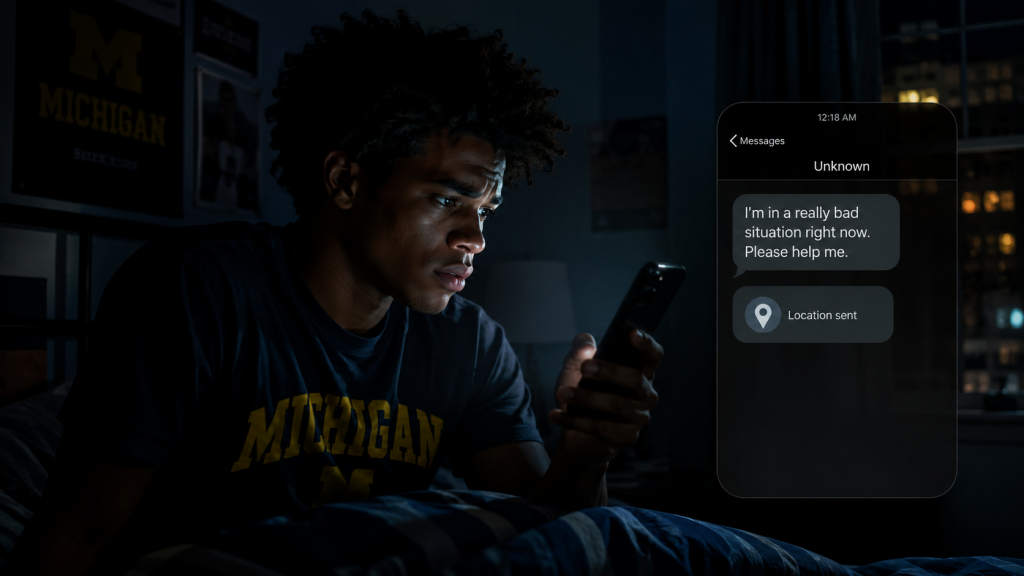
It starts with a text.
Maybe it says something vague like “I don’t feel good about this situation.” Maybe it is a location pin sent without any explanation. Maybe it is three unanswered calls from your friend who never misses a call. Maybe it is a gut feeling from a conversation earlier that something was off and you have not been able to shake it.
You are not there. You are in your own dorm room, your own apartment, across campus or in another city entirely. And something tells you your friend needs help right now.
This is one of the most helpless feelings a person can experience. And it is also one where the actions you take in the next few minutes genuinely matter.
Here is exactly what to do.
Step 1: Take the Signal Seriously Immediately
The most dangerous thing you can do in this moment is talk yourself out of your instinct.
Most people who receive a distress signal from a friend spend the first few minutes debating whether they are overreacting. Maybe she is fine. Maybe I am reading too much into it. I do not want to make a big deal out of nothing.
Harmful situations on campus rarely start as obvious emergencies. They often appear as small red flags that are easy to overlook. That is precisely why your instinct matters. You know your friend. You know what their normal looks like. And if something feels off it probably is.
Do not wait for certainty. Act on the signal you have right now.
Step 2: Try to Make Direct Contact First
Before involving anyone else try to reach your friend directly.
Call them. Do not text. Calling is faster, more personal and gives you real time information about what is happening on their end. If they pick up you will know immediately from their voice whether something is wrong. If they do not pick up that itself is important information.
If they do not answer, text something simple and non-alarming. Something like “hey where are you right now” or “are you okay, call me when you can.” You want to open a door without escalating a situation you do not fully understand yet.
If they respond and confirm they are fine, great. Stay on the line or in the conversation until you feel genuinely reassured. If they do not respond within a few minutes move immediately to the next step.
Step 3: Locate Them as Precisely as You Can
Before you can get help to your friend you need to know where they are.
Think through what you already know. Where were they going tonight? Who were they with? Did they mention a specific location, party, address or part of campus? Check any recent social media activity if that is something your friend does. Look at the last location they shared with you if you have that on your phone.
If you have any mutual friends who might know where they are, contact them immediately. Do not wait to see if your direct contact attempt works first. Run both efforts simultaneously because time matters.
The more specific the location you can provide to someone who can physically help, the faster help arrives.
Step 4: Contact Someone Who Can Get There in Person
This is the most important step and the one most people underestimate.
You cannot be there. But someone can. Your job right now is to activate the person who is closest to your friend’s physical location.
On a college campus, contact campus security or someone at the front desk of a university building. Call campus security directly and give them everything you know. Your friend’s name, physical description, last known location and why you are concerned. Campus security can move across campus faster than most students realize and they are trained to handle exactly these situations.
Contact a mutual friend who is physically nearby. Someone who is at the same party, the same building or the same area of campus. Text them directly. Be specific. “I think something is wrong with our friend, can you go check on her right now.” Do not be vague. Do not soften the request. Be direct so they understand the urgency.
Do not assume someone else has taken action to intervene. One of the most documented failures in emergency situations is the bystander effect, where everyone assumes someone else is handling it so nobody does. Be explicit. Name the person you are asking and ask them directly.
Step 5: Call 911 If There Is Any Immediate Threat
If at any point you believe your friend is in immediate physical danger, call 911.
Do not wait until you are certain. Do not wait until you have exhausted every other option. If your friend told you something that suggested physical danger, if you heard something alarming during a call before it dropped, if the situation feels like it has crossed into emergency territory, call 911 immediately.
When you call give them everything you have. Your friend’s name, physical description, last known location, what you know about the situation and why you are calling. 911 dispatchers are trained to work with incomplete information. Give them what you have and let them work.
Step 6: Use NauNauSOS as Part of Your Emergency Response
Here is something most people do not think about until it is too late.
If your friend has NauNauSOS set up and you are one of their trusted contacts, their one tap SOS alert reaches you instantly the moment they activate it. No missed calls. No texts that get lost. A direct unmistakable signal that your friend needs help right now.
That is the version of this situation where you have the most to work with. You get the alert, you know immediately it is real, and you can move through every step above with the confidence that your friend made the decision to reach out.
But here is the other side of that equation. If you are the one with NauNauSOS set up and your friend does not have it, you lose that direct line. You are dependent on texts that might not get read, calls that might not get answered and signals that are easy to second-guess.
The conversation about setting up NauNauSOS together with your closest friends is one of the most practical safety decisions a college student can make. Not because you expect something to go wrong. Because when something does go wrong the difference between a trusted contact receiving an instant SOS alert and a friend trying to read between the lines of a vague text is enormous.
Set it up together. Add each other as trusted contacts. Walk through what happens when the button gets tapped. And then go live your life knowing the line between you is already open before you ever need it.
Step 7: Stay on the Line and Keep Track of Everything
While you are coordinating help from a distance, stay active.
Keep trying to reach your friend between calls to campus security and mutual friends. Document everything. The times of your attempts, the responses you received, who you contacted and what they said. If this situation escalates into a formal report, that documentation matters.
Stay calm. Not because the situation is not serious but because your calm is what keeps your thinking clear and your communication effective. Panic makes you less useful. Focus makes you more useful.
And once help has reached your friend and you know they are safe, check in on yourself too. Being the person coordinating an emergency from a distance is genuinely stressful and the adrenaline does not always fade quickly.
The Conversation Worth Having Before It Ever Happens
Being an active bystander starts sooner than when someone is in immediate danger. The best version of this situation is one where you and your closest friends have already talked about what to do if something goes wrong.
Make a plan together at the beginning of the semester. Talk about where you go out, who knows your location when you are out alone, and what signal you will use if something feels off. Some friends agree on a code word in text that means I need help without making it obvious to anyone around them.
And set up NauNauSOS together. Right now. Before you need it. Add each other as trusted contacts so that the moment someone taps SOS everyone on that list knows immediately.
That five minute conversation at the beginning of the year is the preparation that makes every step in this guide faster, clearer and more effective when it actually matters.
Download NauNauSOS free today and set it up with the friends who matter most.
If someone is in immediate danger call 911. Crisis Text Line: Text HOME to 741741 988 Suicide and Crisis Lifeline: Call or text 988 Campus Security: Save your campus security number in your phone today.
NauNauSOS. Built for students. Trusted by parents.