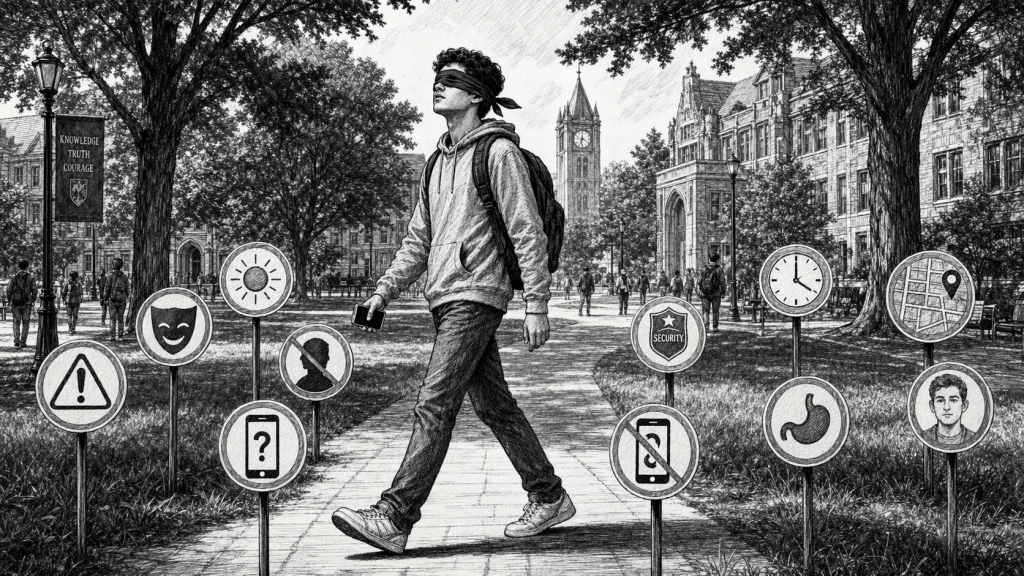
Every student who walks onto a college campus for the first time carries a set of assumptions about what safety looks like there.
Some of those assumptions come from campus tours where guides pointed out the blue light phones and talked about security staff. Some come from conversations with parents who Googled the campus crime report. Some come from just looking around and thinking the place seems pretty fine.
The problem is that assumptions about safety, no matter how reasonable they feel, are not the same as actually being prepared. And when assumptions turn out to be wrong, the cost is not abstract. It is real. A stolen laptop. A missed semester. A situation that escalated because nobody knew fast enough to help.
Here are ten dangerous assumptions that too many college students carry with them onto campus and what each one could actually cost.
1. “This is a safe campus so I do not have to worry”
In 2025, U.S. colleges reported over 22,000 on-campus crimes. Campus crime rose 13 percent in a single year between 2022 and 2023. Even the most prestigious well-funded institutions with dedicated security forces reported significant crime numbers. Stanford saw surges in vehicle theft. Vanderbilt had a violent crime rate of 4.74 per 1,000 students. Yale’s surrounding neighborhoods see higher levels of robbery and assault.
A new campus can foster a false sense of security. That is not a small concern. It is one of the most commonly cited risk factors for college student victimization.
Feeling safe is fine. Using that feeling as a reason to skip preparation is the gap that leaves students without a plan when they actually need one.
2. “Nothing bad happens here during the day”
Most students picture danger as a nighttime phenomenon. Dark paths, late hours, empty parking structures. But a significant portion of campus crimes happen in broad daylight in familiar locations. Theft from dining halls, assaults at daytime events, drug-facilitated incidents at afternoon parties.
Only 17 percent of college students utilize campus security escorts even though 74 percent report feeling unsafe walking home in the dark. That gap between concern and action is partly driven by the assumption that daytime is automatically safer.
Preparedness does not have an on/off switch. Being aware and having a fast way to reach help matters at 2 PM just as much as it does at 2 AM.
3. “I know everyone on this campus so I am safe”
Research consistently shows that the majority of campus crimes are committed by people the victim knows. Most stalkers are former intimate partners or fellow students. Most sexual assaults involve someone the victim had already met. Most incidents of dating violence involve someone the student trusted.
The assumption that danger only comes from strangers is one of the most dangerous ideas a college student can carry. Familiarity is not the same as safety. A new campus can feel like a small tight-knit community very quickly. Take your time to know who you actually trust.
4. “My phone is enough. I can always call someone”
97 percent of college students say they consider their personal safety as they go about daily campus life and try to protect themselves by always carrying their phone. Having a phone feels like a complete safety plan. It is not.
In a genuine emergency, calling requires unlocking your phone, finding the right contact, waiting for the line to connect, and explaining your situation clearly while under extreme stress. Under real pressure, that process falls apart faster than most people expect.
A phone is potential. A plan is what turns potential into action. The students who reach help fastest are the ones who made a decision about what to do before the emergency happened and not during it.
5. “Campus security will handle it if something happens”
Campus security is real and valuable. But it has real limitations. Open and expansive campuses with many buildings make it difficult to maintain consistent coverage and can slow down response times when an incident occurs. Only 26 percent of colleges in the US have a robust system in place to warn students in case of an emergency.
Campus security is your safety net. It is not your first line of defense. Your first line of defense is your own awareness and your own direct connection to the people who can get to you fastest. Those are usually not campus officers. They are your roommate, your parent, your close friend and the people who already know where you are supposed to be.
6. “I will figure out what to do if something happens”
The cost: Wasted critical seconds while your brain tries to make decisions under extreme stress.
This assumption is almost universal and almost universally wrong.
Under genuine emergency stress, the brain’s capacity for clear decision-making drops dramatically. You forget numbers you have memorized. Your hands shake. Actions that take two seconds when calm take twenty seconds when frightened. The students who handle emergencies best are the ones who already knew what they were going to do because they decided in advance.
The moment of an emergency is the worst time to make your safety plan. Make it now. Know what one action you take first. Have it set up and ready before you ever need it.
7. “If I dress appropriately and stay aware I will be fine”
Personal awareness and smart choices genuinely reduce risk. Traveling in groups, staying on well-lit paths, being mindful of your surroundings and trusting your instincts all matter.
But no amount of good behavior makes anyone immune to being in the wrong place at the wrong time. Medical emergencies happen. Random incidents happen. Being careful is not the same as being protected and confusing the two leaves people unprepared for the moments no amount of personal responsibility could have prevented.
8. “I do not live in a dangerous neighborhood so off-campus is fine”
Campus security and blue light phones stop at the campus boundary. But college life does not. Students walk to off-campus housing, take rideshares, go to restaurants and bars in surrounding neighborhoods, and navigate areas that campus security has no jurisdiction over.
The areas immediately surrounding many campuses carry higher crime rates than the campuses themselves. Well-patrolled campuses often sit adjacent to neighborhoods that see more property crime, burglary and assault. The bubble of safety students feel on campus does not follow them when they leave it.
9. “That weird feeling I had was probably nothing”
Campus safety experts, law enforcement professionals and trauma researchers all say the same thing. Trust your instincts. If something does not feel right it probably is not right.
The gut feeling that something is off is not paranoia. It is your brain processing information below the level of conscious thought and flagging something worth paying attention to. Students who dismiss those feelings because they cannot explain them in logical terms are overriding one of their most valuable safety tools.
When something feels wrong, that is the moment to reach for help. Not after you have convinced yourself you were being dramatic.
10. “A safety app is overkill. I probably will not need it”
Only 13 percent of college students participate in campus prevention programs to feel safer. And a similarly small percentage have a dedicated personal emergency tool on their phone beyond their regular contacts.
The assumption that a safety app is overkill is understandable. Most students spend most of their college years without a dramatic emergency. But campus safety is not about the odds on any given day. It is about the one day when the odds do not apply to you.
An app that takes five minutes to set up and costs nothing is not overkill. It is a five minute investment against a situation that you hope never happens but that happens to thousands of real students every year.
What These Assumptions Have in Common
Every single one of these assumptions shares the same structure. They make preparation feel unnecessary. They create reasons to delay a decision that takes almost no time to make and costs nothing to make now.
The students who are safest on campus are not the ones who are most afraid. They are the ones who took a small amount of time before anything happened to close the gap between having potential and having a plan.
NauNauSOS is that plan. Free for college students. Five minutes to set up. One tap when it counts.
Download NauNauSOS today and make the one decision that turns your phone from potential into preparation.
NauNauSOS. Built for students. Trusted by parents.