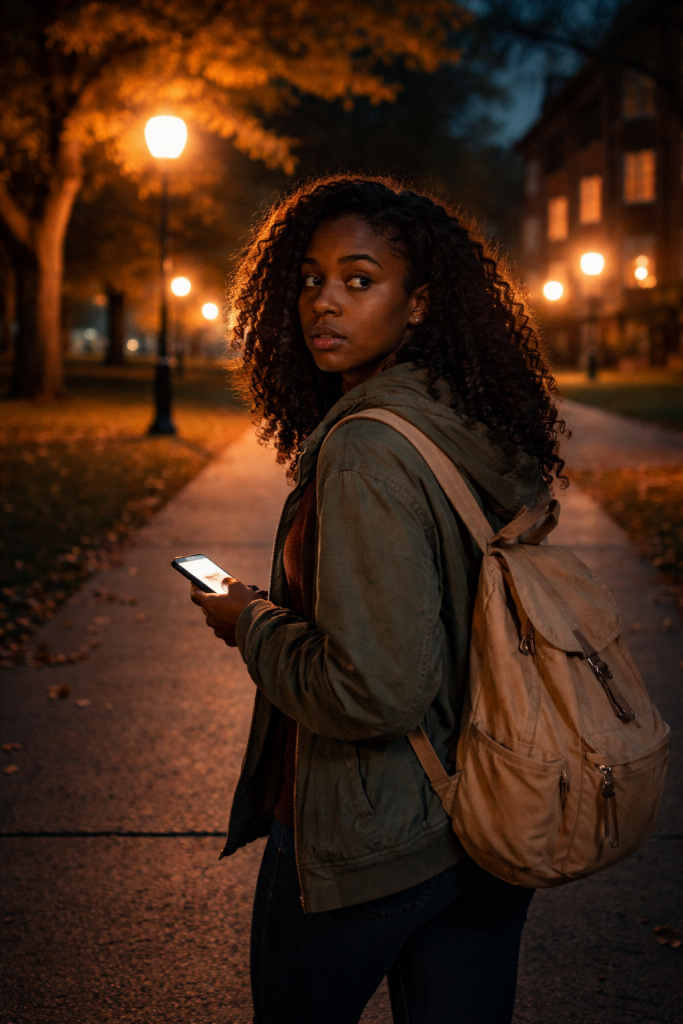
Week one of college is genuinely magical.
Everything is new and bright and full of possibility. The campus looks beautiful. The people seem friendly. The energy is high. Your dorm room feels like freedom. You walk across campus at night and it feels completely fine because there are lights everywhere and other students around and nothing bad has happened yet.
That feeling is real. And it is worth enjoying.
But here is the thing about week one. It is the worst possible time to make decisions about your safety for the rest of the year. Because week one is when your campus looks its most managed, most staffed and most welcoming. It is orientation week. Everyone is trying to make a good impression. The full reality of campus life has not set in yet.
Most students make their safety decisions in that first week glow. And most of them decide they do not need anything extra because the campus feels safe enough.
Here are seven reasons why that decision deserves a second look.
Reason 1: Campus Crime Rose 13% in a Single Year
This is the most important number to start with.
Reported campus crimes increased 13 percent between 2022 and 2023, totaling 22,212 incidents across 635 institutions. That is not a gradual creep. That is a significant single-year jump that happened while most students on those campuses felt just as safe as you do right now.
In 2021 alone, over 31,000 criminal incidents were reported on college campuses nationwide. The most prevalent crimes included burglaries, sexual assaults, motor vehicle thefts and various forms of interpersonal violence.
And critically, these are only the reported crimes. Due to underreporting, officially reported incidents likely do not capture all incidents that occurred. Reported sexual assaults, for example, represented only a minority of sexual assaults that actually happened according to surveys at several large universities.
Your campus being safe-feeling and your campus being crime-free are not the same thing.
Reason 2: The Most Common Crimes Are Not the Ones You Are Watching For
When students think about campus safety they tend to imagine dramatic scenarios. Violent attacks. Active threats. The kind of incidents that make national news.
But the most common campus crimes are much more ordinary. Burglary. Motor vehicle theft. Sexual assault. Stalking. Incidents that happen in dorms, at parties, in parking structures and on quiet paths between buildings.
Motor vehicle theft now tops all campus crimes with over 8,000 incidents in 2023 alone. 81 percent of colleges reported rapes in 2023. Over 70 percent reported other sexual crimes. These are not rare occurrences at a handful of dangerous schools. They are happening across the majority of American campuses right now.
The crimes that are most likely to affect your student are not the dramatic ones they are watching for. They are the quiet ones happening in ordinary moments on ordinary evenings.
Reason 3: New Students Are Specifically More Vulnerable
This is not about character or intelligence. It is just about familiarity.
New students are less familiar with safety resources available on campus. They are navigating high levels of stress during a major life transition. They are more likely to be in unfamiliar situations, going places, they have not been before, meeting people they do not know well yet, making social decisions in environments where the norms are still unclear.
Research identifies a specific period called the Red Zone, roughly the first few months of freshman year, when most campus crimes occur. This is not a coincidence. It corresponds exactly with the period when students feel safest and least prepared. That combination creates real vulnerability that no amount of campus lighting or security cameras fully eliminates.
Reason 4: Campus Security Cannot Be Everywhere
College campuses are large, open and designed for accessibility. That openness is part of what makes them great. It is also part of what makes them difficult to secure fully.
Open and expansive campuses with many buildings make it difficult to monitor activity and potentially slow down response times when an incident occurs. Open layouts also make campuses easy to access for people who are not students.
Even well-resourced campuses with dedicated police forces and sophisticated surveillance systems cannot maintain consistent coverage of every parking structure, every walking path, every off-campus housing area and every late-night situation simultaneously.
The gap between needing help and receiving institutional help is real. And it is often wider than students realize until the moment they need to close it.
Reason 5: The Safest-Seeming Campuses Still Have Serious Crime
This is the one that surprises most families.
Even prestigious well-funded institutions at the top of academic rankings are not immune to significant campus crime. Stanford University has experienced a surge in car and car part thefts. Vanderbilt University had a violent crime rate of 4.74 per 1,000 students despite its elite status. Yale University sees higher levels of violent crime including robbery and assault in the neighborhoods immediately surrounding campus.
Campus reputation and campus crime rate are genuinely separate things. A school can be academically excellent, well-funded, carefully managed and still have meaningful safety challenges that affect real students every year.
Feeling proud of your campus is completely reasonable. But using that pride as a reason to skip preparation is a logic gap worth closing.
Reason 6: The Incidents That Affect Students Most Go Unreported
Here is a quiet truth about campus safety statistics. The numbers consistently undercount reality.
Many victims of campus crime, particularly sexual assault and stalking, do not report what happened. They may not feel supported by institutional processes. They may not be sure what happened qualified. They may be afraid of retaliation or disbelief. Whatever the reason, the official statistics underrepresent the actual experience of students on campus significantly.
This means the campus that reports low crime numbers is not necessarily the campus where nothing is happening. It may simply be the campus where less gets reported. The gap between experience and official record is real and it affects how safe your student actually is regardless of what the annual security report says.
Reason 7: Feeling Safe and Being Prepared Are Two Different Things
This is the most important distinction of all.
Feeling safe is about perception. Being prepared is about having a plan.
A student can feel completely safe on campus and still have no fast way to reach their trusted contacts if something unexpected happens. That feeling of safety is not wrong. The campus probably is reasonably safe most of the time. But reasonable safety most of the time is not the same as having a backup plan for the times when it is not.
A seatbelt does not mean you expect to crash. It means you understand that unexpected things happen and a simple precaution made in advance changes the outcome. Feeling safe on campus is fine. Feeling safe and therefore skipping preparation is the logic gap that leaves students without a plan when they actually need one.
What Actually Being Prepared Looks Like
Being prepared does not mean being afraid. It does not mean assuming something bad will happen or treating campus like a dangerous place.
It means having one tap on your phone that reaches the people who love you most the moment something feels wrong. It means making that decision in week one when you are calm and everything seems fine, not week eight when something has already happened.
NauNauSOS is that one tap. Free for college students. Five minutes to set up. No tracking. No complexity. Just a direct line to your trusted contacts that is ready before you ever need it.
Download NauNauSOS today. Set it up during that first week when everything feels good. And then go enjoy college knowing the plan is already in place.
NauNauSOS. Built for students. Trusted by parents.