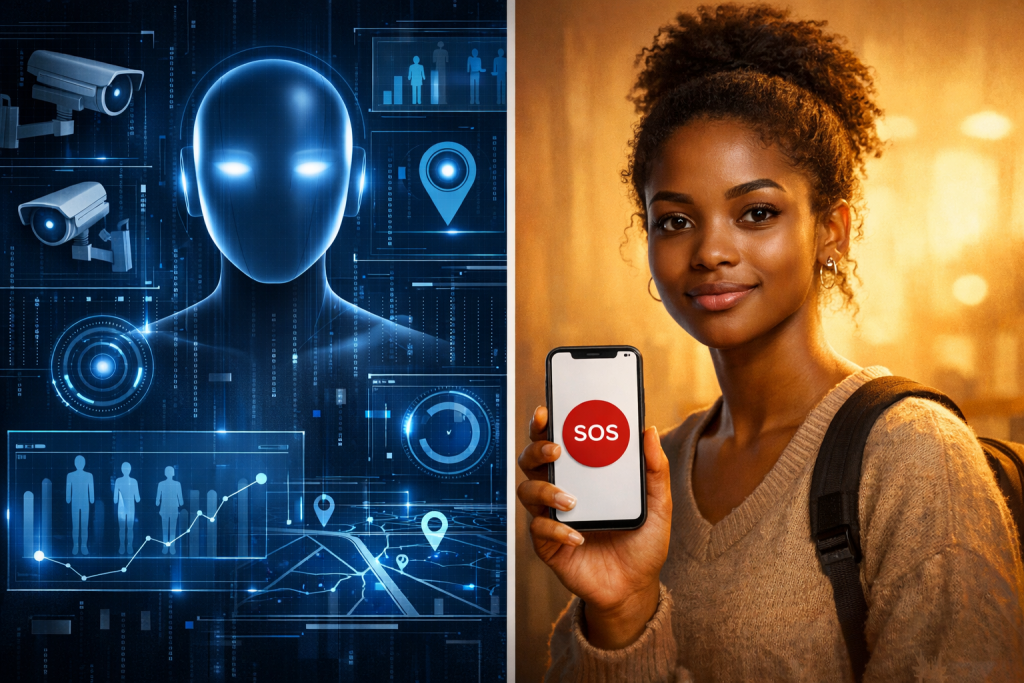
There is a question worth asking before your student downloads the next safety app that shows up in their campus orientation packet.
Does it use AI? And if it does, do you actually know what that means for your student?
Because in 2026, AI is showing up everywhere in campus safety technology. Surveillance cameras that recognize faces. Software that scans student devices 24 hours a day. Apps that analyze behavior patterns and flag anomalies before a human ever reviews them. Algorithms that are making decisions about your student’s safety, privacy and wellbeing in the background without anyone in your family being fully aware of it.
This is not a conspiracy theory. It is the current reality of campus safety technology. And it deserves an honest conversation before your family decides what to put on your student’s phone.
What AI Safety Technology Actually Does on Campus
Let us start with what is actually happening because the picture is more complicated than most families realize.
AI-driven detection technologies are transforming how many campuses monitor and respond to security threats. Smarter surveillance systems are capable of identifying people, vehicles and incidents in real time. Automated alerts and intelligent monitoring allow security staff to move from passive observation to proactive intervention.
AI-powered computer surveillance software is also being used to monitor student behavior on school-issued devices. These programs track online activities to identify early warning signs of self-harm, suicide, bullying or potential violence. Approximately 1,500 school districts across the United States use this kind of technology to track around six million students.
The stated goal of all of this is student safety. And that goal is genuine. Campus safety professionals are dealing with real challenges, and AI offers real capabilities that were not possible a decade ago.
But here is what the sales pitch does not tell you.
Where AI Campus Safety Technology Has Already Gone Wrong
In October 2025, a Maryland school experienced a false alarm when their AI-driven security system misidentified an empty bag of chips as a potential firearm. The result was an armed police response and the detention of a student. The bag of chips was a bag of chips.
That same year, a 13-year-old student in Tennessee was jailed overnight and strip-searched after surveillance software flagged comments she made on a school-issued device. After a human reviewed the situation, it was clear her comments were offensive but not a credible threat.
In a separate investigation by The Seattle Times and The Associated Press, reporters inadvertently received access to almost 3,500 sensitive unredacted student documents through a records request related to AI safety software. Documents in that investigation revealed that LGBTQ students were potentially outed to school administrators through the monitoring systems.
These are not edge cases or rare malfunctions. They are documented incidents from real schools using real AI safety technology in the real world. And they all share the same root cause. AI systems do not understand context. They identify patterns and flag anomalies. They cannot tell the difference between a student joking and a student in crisis. They cannot tell a chip bag from a firearm. They cannot understand that a teenager’s frustrated comment is not a threat.
The technology is powerful. It is also genuinely imperfect. And when it gets things wrong, real students bear the consequences.
The Privacy Problem Nobody Talks About Enough
Beyond the false alarm problem there is a deeper issue that every family with a college student should understand before downloading any AI-powered app.
AI safety apps collect data. A lot of it. Behavior patterns, location history, communication habits, device usage, search terms and more. That data is stored somewhere. It is processed by algorithms. And in most cases, your student has very little control over what happens to it after it is collected.
Constant surveillance affects the way people think, speak and behave. Students who know they are being monitored change how they express themselves. They self-censor. They feel less free to ask honest questions, explore difficult ideas or reach out for help in informal ways because every digital action is potentially being analyzed and flagged.
A report from the National Association of State Boards of Education found that surveillance measures in educational settings interfere with trust and cooperation and cause students to feel less safe for free expression. That is the opposite of what a safety tool should do.
The apps that work best for college students are the ones students actually trust enough to keep on their phones and use when they need them. An app that feels like it is watching you does not get used. An app that respects your privacy and gives you control becomes something you actually rely on.
So Should College Students Use AI Safety Apps?
Here is the honest answer.
It depends entirely on what the app is doing with AI and whether that use of AI actually makes you safer or just makes you feel safer.
AI surveillance that monitors your location 24 hours a day, scans your device activity, or builds a behavioral profile of your student is not a personal safety tool. It is institutional monitoring with a safety label attached. That kind of AI may have legitimate uses in campus security infrastructure. But it is not what your student needs on their personal phone.
AI that genuinely improves the speed, reliability or accuracy of an emergency alert, without collecting unnecessary data and without creating surveillance infrastructure, could be a legitimate enhancement to a safety tool. The question to ask is simple. What data is being collected, who has access to it, and what happens to it in a non-emergency?
If the app cannot answer that question clearly, that is your answer.
What Actually Works: Human Connection Over Machine Surveillance
Here is what the research consistently shows about what makes students actually feel safer on campus.
Having a direct, fast line to the people they trust most. Not an algorithm watching their behavior. Not a campus security feed analyzing their movements. The knowledge that if something feels wrong, the person who will drop everything for them is reachable in seconds.
That is not a technology problem. That is a relationship problem. And the best safety tools for college students are the ones that strengthen that human connection rather than replacing it with machine oversight.
NauNauSOS does not use AI to monitor your student. It does not analyze behavior, scan devices, or build data profiles. It does one thing. When a student taps SOS, an instant alert goes to the trusted contacts they chose. Real people who know them. People who will respond not because an algorithm told them to but because they love them.
That is not a limitation. That is the point.
In a world where AI is taking over campus safety technology, NauNauSOS is the app that kept the human in the middle of the most important moment. The emergency. The one tap. The people who matter.
The Question to Ask Before Your Student Downloads Any Safety App
Before your student installs any safety app, ask these three questions.
Does it use AI to monitor behavior or device activity? If yes, understand exactly what it is collecting and who has access to that data before downloading.
Does it require constant location access even outside of emergencies? If yes, that is not a safety app. That is a tracking tool.
Does it give your student control over when and how the alert goes out? If not, the app is not built for your student. It is built for whoever is receiving the data.
NauNauSOS answers all three questions the right way. No behavior monitoring. No passive location tracking. Full student control over every alert.
In 2026, knowing what your safety app actually does is just as important as having one.
Download NauNauSOS free today and choose the safety tool that puts your student in control.
NauNauSOS. Built for students. Trusted by parents.